
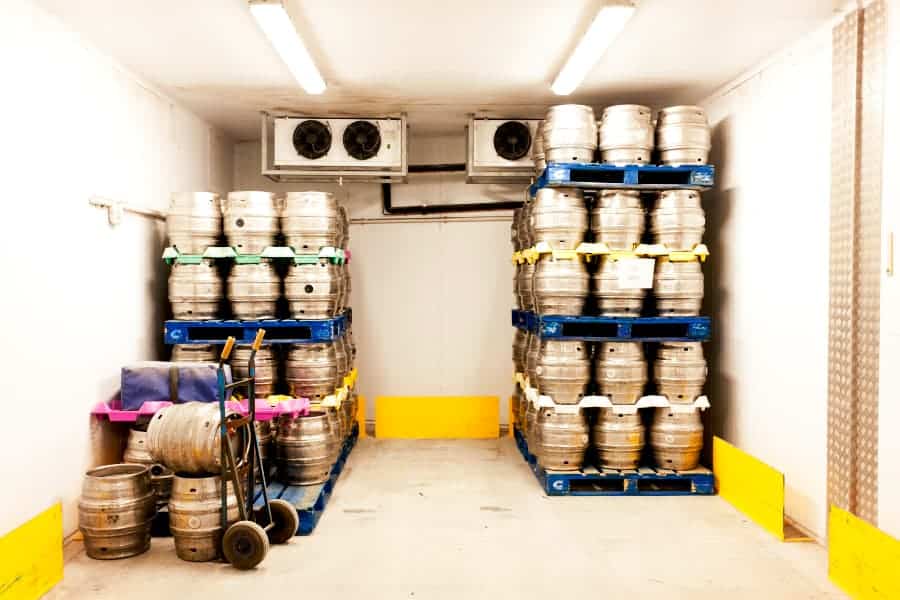
On paper, brewery storage seems simple. All you need is a unit that can keep beers cold, organized, and accessible for sales. In reality, a walk-in beer cooler must be fine-tuned to balance competing demands. The cooler must keep beers at the optimal temperature for serving despite being opened constantly. It must also allow seamless access to kegs, cases, bottles, and other formats.
American Cooler Technologies provides custom commercial coolers and freezers for a wide variety of industries and businesses nationwide. Here, we discuss how to choose a cooler that meets all these requirements and more.
Key Takeaways
- Start by determining your storage needs, including capacity, beverage format, restocking cycle, and peak inventory during overflow periods.
- Plan the interior layout to maximize storage without limiting airflow or accessibility. Keep aisles wide to allow for easy loading and unloading.
- Back-of-house coolers should have heavy-duty doors with internal latch releases and reinforced kickplates. Customer-facing coolers should have glass doors for visibility.
- A temperature of approximately 38°F is common for draft beer storage and dispensing, although optimal temperatures vary by beer style, carbonation level, and dispensing system.
Determining Your Storage Needs
Before you choose your dimensions, think about your storage needs. Breweries store products in a variety of formats, not to mention ingredients, bar snacks, or other items. Consider the following questions when determining your capacity:
- Will you store kegs, cans, bottles, or a combination of all three?
- Do you need to chill ingredients or specialty products?
- Do you restock weekly, multiple times a week, or daily?
- Will you store extra inventory for holiday or seasonal demand?
- Do you expect to grow your production?
A walk-in cooler should be sized for peak volume and traffic. If you base cooler specifications around the average day, you’ll find it overcrowded and inaccessible on high-traffic days when fast access is the most important.
Planning the Interior Cooler Layout
After calculating your storage capacity, it’s time to plan the interior layout. Product must be stacked to maximize storage while staying accessible for staff. You also want to avoid blocking airflow. Different product formats also have different demands:
- Kegs: Prioritize wide aisles for movement, stable stacking, quick access to popular kegs, an open area near the door, and space for rotation.
- Cases: Prioritize sturdy shelving, easy labeling, clearance between stacks for airflow, and quick access for picking during rush periods.
- Mixed: Intentionally define areas for kegs and areas for cases. This lets you create storage solutions that are best suited to each format.
You should also plan your foot traffic. Aisle widths should accommodate the equipment used to move kegs and cases, such as forklifts, including sufficient clearance for turning and safe handling. Confirm the required dimensions using the equipment manufacturer’s specifications and applicable workplace safety requirements.
Selecting the Cooler Door Configuration
Brewery walk-in coolers are accessed frequently. To keep the door closed and prevent fluctuations, strategic door placement is important. Start by determining whether the cooler will have back-of-house or customer-facing access. This will inform your door requirements:
- Back-of-house: Get a heavy-duty door that swings outward into the room. Look for inside safety releases, durable door hardware, and reinforced kickplates. Heated door frames may be appropriate where condensation or icing is a concern.
- Customer-facing: Get a glass entrance with a sliding door to avoid blocking aisles. Look for anti-sweat sensors or a heated frame to maintain mobility.
Keep high-turnover beverages near the entrance. Make sure all products are clearly labeled to avoid long search times in the box.
Setting the Right Cooler Temperature
Finally, you want to set the cooler at the right temperature. Lower temperatures help carbon dioxide remain dissolved in beer, while warmer temperatures encourage it to escape. Improper temperature or pressure balance can cause excessive foaming or affect the beer’s carbonation and presentation.
The ideal temperature for mixed-beer setups is usually 38°F, with a safe operating range between 36°F and 40°F. Breweries that only serve one beer type can tailor their cooler temperatures toward that beer. Light beers should be kept colder at 34°F to 38°F. Dark or heavy beers can be warmer, at 40°F to 44°F, to develop a richer flavor and aroma.
Design Your Brewery Walk-In Cooler
Design the ideal walk-in beer cooler for your business with American Cooler Technologies. Based in Michigan, we manufacture custom walk-in coolers for breweries, restaurants, and other businesses across the nation, offering American craftsmanship and a customer-focused service model. Contact us today to learn more about our products or to get advice on choosing a brewery cooler.
Frequently Asked Questions About Brewery Coolers
What temperature should a brewery keg cooler be?
Generally, a brewery cooler for mixed setups should maintain a temperature between 36°F and 40°F, with an optimal temperature of 38°F. This range is warm enough to release carbon dioxide but cold enough to prevent foaming. If you are chilling light beers only, then slightly colder temperatures (34°F to 38°F) are better, while dark beers develop a richer flavor profile at a slightly warmer range of 40°F to 44°F.
How many kegs fit in a walk-in cooler?
The number of kegs that fit in a cooler depends on the size of the cooler. Generally, a standard 8×8-foot cooler can hold about 28 to 30 kegs, while a larger unit can fit many more. American Cooler Technologies manufactures custom-made coolers to match your exact requirements for storage.
Should a brewery cooler have a floor drain?
A floor drain may be beneficial or required for a brewery walk-in cooler, depending on its use, cleaning procedures, and applicable plumbing and health codes. Drainage should be considered during the initial design.
How wide should brewery cooler aisles be?
The walk-in cooler aisle for a brewery should be at least three to four feet wide to let staff members carry cases or use a hand truck comfortably. If you plan to use a pallet jack or forklift, then you will need at least 8 to 12 feet of aisle clearance.
Can a brewery cooler be expanded later?
Yes, a brewery cooler can be expanded if it is designed with modular cam-lock panels and has sufficient cooling power. Modular panel design lets you unbolt a wall and add new panel sections to lengthen or widen your cooler footprint. This lets you keep the cooler small enough to avoid overpaying for energy, but with the option to create extra storage capacity when you need it.